

Live Events are Back!
Now that Freedom Day has finally arrived it could finally be the light at the end of the tunnel that we have all been waiting for!
The live event industry has taken a massive hit from the impact of COVID-19 and the enforced government lockdowns. Like many industries it has tried its best to adapt with virtual performances and drive-thru gigs, but ultimately it’s not an industry that can really give its best performance through screens or by socially distancing!
Live events are all about people getting together and having a good time, and now that is needed more than ever.

Understandably there is still a lot of caution, after all even though the vaccine program is doing a great job there is still a lot of work to do. The virus hasn’t gone away, so it is important that there are still measures in place to keep it at bay. It seems like now the government is pushing for society to take the lead and to make their own decisions and act responsibly.
Businesses always have a big part to play in society because we rely on them to set the tone and provide a service for the things we need.
Many businesses in the hospitality and events industry have had a very raw deal throughout the pandemic with their businesses and livelihoods taking a big hit, it is quite something when overnight you get told that your business and only income, which you have spent years building and developing is all of sudden cut off completely.
A lot of businesses didn’t get government support and unfortunately when some help was finally available it was too late and sadly, they had to call it a day.
So now it is down to the surviving businesses to help shape the landscape of the hospitality and events sector to make it a safe place for people to return whilst trying to recover their livelihoods.
These businesses have a lot of responsibility on their shoulders it won’t be an easy task to try and bring back this industry after everything it has been through.
Innovation will be key, it is usually the thing that pushes society forward and helps in challenging situations such as what we are facing. The event industry has seen a lot of innovation in the last few years, one of the key areas was in the handling of tickets and resale.
This is because promoters wanted to control the flow of tickets and to keep everything in a closed loop so only promoters can profit from any sale of tickets.

This makes sense if you are a promoter or artist that wants to get the most money from your event, but the reality of this means less freedom for the people buying the tickets.
And when we are looking at businesses to help shape the future of the sector to help make the return of live events as safe as possible, one of the things everyone needs more than ever after Freedom Day is the freedom to do whatever they want with their own event ticket.
If someone gets pinged a few days before an event and they can’t get a refund, we should all have the freedom to give that ticket to a family member, friend or try and get a bit of money back from whatever resale platform we choose.
We all understand that event businesses don’t like to give refunds because it is bad for their business models, but if that is the case then people need to be given more freedom with their tickets so they make the right choices.
The last thing we want is lots of people ignoring government guidance and turning up to events potentially having COVID-19, because they don’t want to lose out on their hard earned money and end up creating mass spreading events.

It is understandable after a difficult year most promoters that are setting up events will look to make the most money they can and ultimately, they will want to keep people safe as well, but for that to really happen people need to have the protection financially so that they can do the right thing so everyone is kept safe.
The most important part of the much needed return of live event sector is to make sure that it is set up in a way that people are kept as safe as possible and we will be relying on the industry businesses to set that tone, we can only hope that they will make decisions that benefit people rather than looking to protect themselves and their businesses.
The pandemic has given a lot of people time for reflection and evaluate what works and what doesn’t.
One of the things that doesn’t work in the live events industry is the stronghold that big businesses have on the freedom of what people can and can’t do with the tickets they buy. No refunds allowed. No resale allowed. No transfers allowed. All hidden behind terms and conditions, which no one really notices until something goes wrong and they can’t go to an event!
If the industry can learn anything from this pandemic is that there is a place for a responsible free ticket resale market and it is needed more than ever.
 Today’s blog is all about ticket restrictions and the impact on consumers.
 The main issue with ticket restrictions is what happens if for whatever reason fans chose to not use the ticket they have purchased, with many tickets being purchased up to a year in advance anything could change.
If the original purchaser doesn’t use the ticket then it is worthless, just a piece of paper. It is not possible to obtain a refund because ticket companies don’t give refunds. It is also not possible give it to someone, even for free.
There are however some options available to consumers, one of the options is the fan to fan resale, these are secondary ticket companies that are made available by the promoter or primary ticket companies. They offer a resale facility that sets a cap of 10% over the Face Value of the ticket, they also charge a fee ranging from 10-20%.
The issue with the fan to fan resale websites is they are set up as an afterthought, they are lacking in marketing, which means the chances of the tickets selling are low. The main reason they are set up is to give consumers an option to do something with the unwanted tickets, which is great when it works, unfortunately it’s not competitive enough to give consumers the support they need.
The fan to fan 10% capped market has seen an increase in popularity with some of the bigger names in primary ticketing getting involved, these are the ticket companies that already dominate the primary market and now they have set their sights on the secondary market. These restrictions and vertical integrations will keep the tickets in a closed loop, which allows strict control at every stage of the ticket’s life cycle. It could be argued that this creates a monopolistic control of the tickets and events, leaving consumers with limited options when it comes to buying and reselling tickets.
The government department Competition & Markets Authority believes consumers should have the right to resell tickets, that is why they incorporated it into their legislation in the Consumers Rights Act 2015.
They make it very clear that an event organiser cannot cancel a ticket merely because that ticket has been resold.
This is why it creates confusion and a grey area for consumers buying and reselling tickets, on the one side the CMA say resale is allowed and on the other promoters are saying that they don’t allow resale of their tickets, unless it is with a resale partner that they specify.
It is also important to point out that primary ticket prices are on the increase, not all fans have the financial freedom to throw away tickets or at the very least make a substantial loss on their original purchase. When circumstances change a fans experience of the ticket industry can change very quickly, they can soon realise they have very few options if any at all to recoup their money.
Fans shouldn’t have to take a gamble a year in advance on whether they will be able to attend an event or not, they should be able to purchase a ticket and look forward to that event and if, for whatever reason plans change then they should be within their rights to do whatever they want with their ticket.
All of this has been in reference to the resale of tickets but another big sector that will take an impact from restrictions is the gift market, consumers love to give event tickets as gifts to friends and family. This will no longer be an option for consumers as in the desperation to control tickets this area has not been addressed, it is just another freedom that has been taken away from the fans.
We think everyone agrees that the ticket industry requires an evolution, something needs to be done to make it workable for all involved, but are ticket restrictions really the answer that fans are looking for?
The main issue with ticket restrictions is what happens if for whatever reason fans chose to not use the ticket they have purchased, with many tickets being purchased up to a year in advance anything could change.
If the original purchaser doesn’t use the ticket then it is worthless, just a piece of paper. It is not possible to obtain a refund because ticket companies don’t give refunds. It is also not possible give it to someone, even for free.
There are however some options available to consumers, one of the options is the fan to fan resale, these are secondary ticket companies that are made available by the promoter or primary ticket companies. They offer a resale facility that sets a cap of 10% over the Face Value of the ticket, they also charge a fee ranging from 10-20%.
The issue with the fan to fan resale websites is they are set up as an afterthought, they are lacking in marketing, which means the chances of the tickets selling are low. The main reason they are set up is to give consumers an option to do something with the unwanted tickets, which is great when it works, unfortunately it’s not competitive enough to give consumers the support they need.
The fan to fan 10% capped market has seen an increase in popularity with some of the bigger names in primary ticketing getting involved, these are the ticket companies that already dominate the primary market and now they have set their sights on the secondary market. These restrictions and vertical integrations will keep the tickets in a closed loop, which allows strict control at every stage of the ticket’s life cycle. It could be argued that this creates a monopolistic control of the tickets and events, leaving consumers with limited options when it comes to buying and reselling tickets.
The government department Competition & Markets Authority believes consumers should have the right to resell tickets, that is why they incorporated it into their legislation in the Consumers Rights Act 2015.
They make it very clear that an event organiser cannot cancel a ticket merely because that ticket has been resold.
This is why it creates confusion and a grey area for consumers buying and reselling tickets, on the one side the CMA say resale is allowed and on the other promoters are saying that they don’t allow resale of their tickets, unless it is with a resale partner that they specify.
It is also important to point out that primary ticket prices are on the increase, not all fans have the financial freedom to throw away tickets or at the very least make a substantial loss on their original purchase. When circumstances change a fans experience of the ticket industry can change very quickly, they can soon realise they have very few options if any at all to recoup their money.
Fans shouldn’t have to take a gamble a year in advance on whether they will be able to attend an event or not, they should be able to purchase a ticket and look forward to that event and if, for whatever reason plans change then they should be within their rights to do whatever they want with their ticket.
All of this has been in reference to the resale of tickets but another big sector that will take an impact from restrictions is the gift market, consumers love to give event tickets as gifts to friends and family. This will no longer be an option for consumers as in the desperation to control tickets this area has not been addressed, it is just another freedom that has been taken away from the fans.
We think everyone agrees that the ticket industry requires an evolution, something needs to be done to make it workable for all involved, but are ticket restrictions really the answer that fans are looking for? 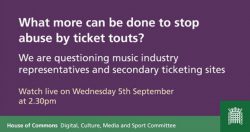 How is it possible to have a balanced argument and create solutions when the people running the enquiry are already displaying a pre-conceived agenda?
It is important to have a balanced argument and to go into the enquiry with an open mind if the objective is to find a solution. Otherwise the danger is that the enquiry will end up getting caught in the same old cycle of asking the same people, the same old questions and then wonder why they get the same answers and no solutions.
First up in the hot seat were the primary players, they were Stuart Galbraith from Kilimanjaro, Andrew Parsons from TM UK, Adam Webb from FanFair Alliance and Lucinda Brown from Islington Assembly Hall.
They all shared their views on the current state and the future of ticketing, pretty much all agreeing that technology was the solution but it wasn’t quite there yet. It can possibly work well for smaller venues like Islington Assembly Hall, but it would be more difficult for larger venues to take it on at the moment.
The FTA has always been an advocate of technology being used to make the buying experience easier and safer for consumers, the only issue we would have is the free transferability of tickets with no restrictions. Technology could be of great benefit if it is used in the best interest of consumers and not just a means to control tickets.
There was also mention of the need for the CMA to step up its enforcement of the Consumer Rights Act. To put further pressure on resale sites to make sure that people listing on their sites are compliant, for example listing seat details, face value, business details etc.
We are completely in agreement with that and we have been pushing for it from the very start, we know that in order for consumers to have the best buying experience they need to have all the necessary information. However, we do believe that all resale sites need to adhere to this not just the big four.
There has been a lot of talk of non-compliant secondary sites and that is something that the CMA needs to address, there are also a lot of fan to fan resale businesses operating today that are also not CMA compliant, these businesses are just as much of a concern for consumers as any other resale sites. In order for resale to work properly they all have to play by the same rules.
The FTA and its members are bound by our code to conduct business in a responsible way, putting fans at the forefront of the decisions we make, without them no part of this industry has a future. This is an important point to remember, which is why we always strive to fight for fans rights. We only work with compliant resale sites because we believe consumers need to be protected by the U.K laws when making ticket purchases. We recognise that there are traders and secondary sites that don’t adhere to the laws, and it is our mission to make sure the secondary market is cleaned up so that doesn’t continue to happen.
The issue of selling tickets for restricted events was also mentioned, and it was repeatedly said that if a ticket was listed correctly in accordance to CMA guidelines with seat details, then it would make it easier to cancel tickets so that the issue of resale could be dealt with.
This approach is very concerning, as consumers have the right to resell tickets in accordance to the CMA CRA 2015 guidelines. The CMA made it very clear that primary ticket sellers can’t take away a consumer right to resell a ticket. Promoters/artists/primary ticket agents would be in breach of CRA 2015 if they cancel consumers tickets just because they have been listed for resale. No one in the committee addressed this point and the FTA feel they let consumers rights down here, they were too quick to try and protect promoter/artist rights that they forgot about the consumers rights.
The issue of bots also got brought up and there was a lot of talk of how best to deal with the issue, it was mentioned that bots are a global issue, which makes it hard to control and police.
The FTA has always been against the use of bots, we welcomed the recent legislation which made the use of them illegal in the UK. We have also said that because the internet is global unfortunately the bot law will do little to combat anything that happens overseas.
It was disappointing that there were few questions about Ticketmaster’s Platinum, as the way they have conducted it recently with their drip feeding of tickets and high prices we feel it isn’t very consumer friendly.
It was good to see that Damian Collins saw through the so called altruistic reason why TM announced the closure of GetMeIn and Seatwave. He said that the main reason to close them down was financial rather than in the best interest for fans. GetMeIn and Seatwave were loss making businesses. Damian Collins also highlighted the fact that TM are only shutting down their resale in the UK and Europe, so it can’t be for a moral reason if they are happy to keep it going in the U.S.
Overall the enquiry into the primary side of the music industry was pretty much the same as it has always been, there were still the same questions of how to stop ‘touts’, bots and the ‘rip off’ prices. And unfortunately, less questions about what primary can do to make sure fans know what chances they have to get a ticket, transparency on where all the ticket allocations are going, what is being done to keep business competition within the sector to help keep prices competitive for consumers and what is the benefit of TM Platinum to consumers?
We just feel that this was a real chance to get at the heart of the issues that consumers face, for too long all eyes have been focused on the secondary market and no one has stopped to think, why is it there in the first place? Our answer to that is the primary market doesn’t cater for all consumers needs, it assumes that all fans are the same but this is far from what everyone who has a role in the secondary market has seen over the years. The secondary market underpins all of the shortfalls of the primary and that is why it is so vital to so many consumers.
How is it possible to have a balanced argument and create solutions when the people running the enquiry are already displaying a pre-conceived agenda?
It is important to have a balanced argument and to go into the enquiry with an open mind if the objective is to find a solution. Otherwise the danger is that the enquiry will end up getting caught in the same old cycle of asking the same people, the same old questions and then wonder why they get the same answers and no solutions.
First up in the hot seat were the primary players, they were Stuart Galbraith from Kilimanjaro, Andrew Parsons from TM UK, Adam Webb from FanFair Alliance and Lucinda Brown from Islington Assembly Hall.
They all shared their views on the current state and the future of ticketing, pretty much all agreeing that technology was the solution but it wasn’t quite there yet. It can possibly work well for smaller venues like Islington Assembly Hall, but it would be more difficult for larger venues to take it on at the moment.
The FTA has always been an advocate of technology being used to make the buying experience easier and safer for consumers, the only issue we would have is the free transferability of tickets with no restrictions. Technology could be of great benefit if it is used in the best interest of consumers and not just a means to control tickets.
There was also mention of the need for the CMA to step up its enforcement of the Consumer Rights Act. To put further pressure on resale sites to make sure that people listing on their sites are compliant, for example listing seat details, face value, business details etc.
We are completely in agreement with that and we have been pushing for it from the very start, we know that in order for consumers to have the best buying experience they need to have all the necessary information. However, we do believe that all resale sites need to adhere to this not just the big four.
There has been a lot of talk of non-compliant secondary sites and that is something that the CMA needs to address, there are also a lot of fan to fan resale businesses operating today that are also not CMA compliant, these businesses are just as much of a concern for consumers as any other resale sites. In order for resale to work properly they all have to play by the same rules.
The FTA and its members are bound by our code to conduct business in a responsible way, putting fans at the forefront of the decisions we make, without them no part of this industry has a future. This is an important point to remember, which is why we always strive to fight for fans rights. We only work with compliant resale sites because we believe consumers need to be protected by the U.K laws when making ticket purchases. We recognise that there are traders and secondary sites that don’t adhere to the laws, and it is our mission to make sure the secondary market is cleaned up so that doesn’t continue to happen.
The issue of selling tickets for restricted events was also mentioned, and it was repeatedly said that if a ticket was listed correctly in accordance to CMA guidelines with seat details, then it would make it easier to cancel tickets so that the issue of resale could be dealt with.
This approach is very concerning, as consumers have the right to resell tickets in accordance to the CMA CRA 2015 guidelines. The CMA made it very clear that primary ticket sellers can’t take away a consumer right to resell a ticket. Promoters/artists/primary ticket agents would be in breach of CRA 2015 if they cancel consumers tickets just because they have been listed for resale. No one in the committee addressed this point and the FTA feel they let consumers rights down here, they were too quick to try and protect promoter/artist rights that they forgot about the consumers rights.
The issue of bots also got brought up and there was a lot of talk of how best to deal with the issue, it was mentioned that bots are a global issue, which makes it hard to control and police.
The FTA has always been against the use of bots, we welcomed the recent legislation which made the use of them illegal in the UK. We have also said that because the internet is global unfortunately the bot law will do little to combat anything that happens overseas.
It was disappointing that there were few questions about Ticketmaster’s Platinum, as the way they have conducted it recently with their drip feeding of tickets and high prices we feel it isn’t very consumer friendly.
It was good to see that Damian Collins saw through the so called altruistic reason why TM announced the closure of GetMeIn and Seatwave. He said that the main reason to close them down was financial rather than in the best interest for fans. GetMeIn and Seatwave were loss making businesses. Damian Collins also highlighted the fact that TM are only shutting down their resale in the UK and Europe, so it can’t be for a moral reason if they are happy to keep it going in the U.S.
Overall the enquiry into the primary side of the music industry was pretty much the same as it has always been, there were still the same questions of how to stop ‘touts’, bots and the ‘rip off’ prices. And unfortunately, less questions about what primary can do to make sure fans know what chances they have to get a ticket, transparency on where all the ticket allocations are going, what is being done to keep business competition within the sector to help keep prices competitive for consumers and what is the benefit of TM Platinum to consumers?
We just feel that this was a real chance to get at the heart of the issues that consumers face, for too long all eyes have been focused on the secondary market and no one has stopped to think, why is it there in the first place? Our answer to that is the primary market doesn’t cater for all consumers needs, it assumes that all fans are the same but this is far from what everyone who has a role in the secondary market has seen over the years. The secondary market underpins all of the shortfalls of the primary and that is why it is so vital to so many consumers.